<!DOCTYPE html>
How to Troubleshoot an AC That Won’t Turn On Before Calling a Pro | Day & Night Air Conditioning, Heating, & Plumbing
Body font-family: Arial, Helvetica, sans-serif; line-height: 1.6; color: #232323; margin: 0; padding: 0; background: #f7f7f7;
.container max-width: 920px; margin: 24px auto; background: #fff; border: 1px solid #ddd; box-shadow: 0 2px 6px rgba(0,0,0,0.05);
.box padding: 24px;H1, h2, h3 color: #133c55; margin-top: 0;
P margin: 14px 0;.note background: #f0f7ff; border-left: 4px solid #2a6f97; padding: 12px 16px; margin: 18px 0;
.cta background: #133c55; color: #fff; padding: 18px; border-radius: 4px;.cta a color: #fff; text-decoration: underline;
.grid display: grid; grid-template-columns: 1fr; gap: 14px;@media(min-width: 760px) .grid-2 grid-template-columns: 1fr 1fr;
Ul, ol margin: 12px 0 12px 18px;Li margin: 6px 0;
.fineprint font-size: 0.9em; color: #666;.badge display: inline-block; background: #e9f5ff; color: #0b3954; padding: 4px 8px; border-radius: 4px; margin-right: 6px;
How to Troubleshoot an AC That Won’t Turn On Before Calling a Pro
Phoenix runs on air conditioning. The Valley of the Sun hits 110°F and higher for long stretches.
When a central air conditioner, heat pump, rooftop unit, or mini-split will not start, the home warms fast and the risk increases for kids, pets, and older adults.
This practical guide shows what a Phoenix homeowner can safely check first.It also explains what failures are common in Maricopa County due to heat, dust, and monsoon surges.
If anything feels unsafe or out of reach, stop and request AC repair Phoenix from Day & Night Air Conditioning, Heating, & Plumbing.The team provides 24/7 emergency air conditioning repair near me with same-day response across Phoenix, AZ.
Day & Night is a licensed, bonded, and insured HVAC contractor (ROC #133378) serving residential and commercial clients.
The company fields NATE-certified technicians and offers a fixed-price guarantee.Trucks carry heavy-duty start capacitors and universal contactors to solve frequent no-start issues on the first visit.
First checks that solve a large share of no-start calls
Many “dead” systems are not dead. A handful of quick checks can bring the system back online without tools.
These are safe for most homeowners in Phoenix condos, single-family homes, and townhomes from Arcadia to Ahwatukee Foothills.
- Confirm the thermostat mode and setpoint. Set Cool and a temperature at least 3°F below the current room reading. Replace thermostat batteries if present.
- Check the indoor unit switch and blower door. The air handler or furnace has a service switch. The blower door must seat the door safety switch.
- Inspect the breaker panel. Look for tripped HVAC or AC breakers. Reset once by pushing fully off, then on. If it trips again, stop and call.
- Look for a tripped condensate float switch. A backed-up drain pan near the air handler or in the attic can shut the system down. Clear the pan if safe.
- Replace a clogged air filter. A collapsed or loaded filter can trigger limit switches and prevent blower start. Use the right MERV rating for your system.
If these steps restore operation but the system shuts down again, there may be a deeper problem such as a faulty contactor, a failed start capacitor, or high static pressure due to duct issues.
Why Phoenix systems refuse to start: local patterns Day & Night sees daily
Phoenix systems face long duty cycles, monsoon moisture bursts, fine desert dust, and heat soak on roofs.
These conditions push control boards, contactors, and capacitors to their limits.Below are common root causes the team sees across neighborhoods like Biltmore, Desert Ridge, Maryvale, Paradise Valley Village, Sunnyslope, North Mountain, South Mountain, and the Arcadia 85018 corridor.
1) Faulty start capacitors and fried contactors
A start capacitor boosts the compressor or condenser fan at startup. Phoenix heat drives higher amperage on start.
Swollen, leaking, or open capacitors prevent the outdoor unit from engaging.
Contactors pit and carbonize under high load and surge activity during monsoon lightning.
Symptom: You hear a click at the outdoor condenser, or a soft hum, and the fan blade does not spin.
Another sign is a breaker that holds but no compressor activity.A screwdriver “push start” trick on the fan blade is dangerous and not advised.
Field note: Day & Night trucks carry heavy-duty start capacitors and universal contactors.
That means many no-start calls in 85032 and 85050 get solved on the first trip.
2) Low-voltage control failures
Heat and vibration fatigue transformer windings. A short in the low-voltage circuit or a kinked thermostat cable can pop the 3A or 5A blade fuse on the control board.
On rooftops in Desert Ridge and near Phoenix Sky Harbor International Airport, UV and roof heat accelerate insulation breakdown on control wires.
Symptom: Thermostat appears normal but calls for cool do nothing. No condenser click. The indoor blower may not start.
An experienced tech checks for 24V across R and C, and tests Y call to the contactor.
3) High-pressure or low-pressure lockouts
Thick dust on the condenser coil reduces heat rejection. Head pressure rises and the high-pressure switch trips.
In other homes, low airflow across the evaporator coil or a refrigerant leak drops suction pressure. That can trip a low-pressure switch or trigger a freeze condition and a shutdown.
Symptom: The system may try to start, then stop. Later it will start again and stop.
In some packages and rooftop units, the control board logs an HP or LP fault.
Warm air complaints often follow.
4) Clogged condensate drain lines and float switches
Phoenix attics are harsh. Long drain runs sag and grow algae during the monsoon. A float switch inside the primary pan or secondary pan cuts power to protect the ceiling.
A tell is water in the secondary pan and a silent system.
5) Thermostat and power issues
Some Wi-Fi stats lock into safety delays or lose settings after a surge.
APS or SRP events can layer short outages that cause compressor short-cycling protection.Many controls need up to five minutes after power restore before compressor restart.
Safe homeowner checks with a little more depth
If the first checks do not help and you feel comfortable, these extra items can save a service call.
If the system needs panel removal or roof access, wait for a pro. Phoenix rooftops can exceed 160°F in peak sun.
- Listen at the condenser. Silence points to no 24V signal or a tripped breaker. A hum without fan spin hints at a failed start capacitor or seized fan motor.
- Check the time delay. After any breaker reset or power blip, give five minutes for the compressor anti-short-cycle timer before judging a failure.
- Verify the filter size and MERV. Phoenix dust loads filters fast. If static pressure rises, some furnaces lock out. MERV 8 to 11 fits many homes; higher MERV needs proper duct design.
- Look outside at the condenser coil. If it is caked with lint and dust, reduce usage and call. Do not pressure-wash fins. Bent fins and water into controls cause bigger failures.
- Check the condensate safety. If the float switch is up, the line likely needs a wet vac pull or condensate treatment. If the pan is full, shut the system off to protect drywall.
Do not add refrigerant yourself. R-410A pressures are high. Overcharge or contamination can burn the compressor and void warranties.
Appliance types across Phoenix and how no-start issues differ
Central air conditioners, split-system heat pumps, ductless mini-splits, packaged units, and rooftop units (RTU) share a cooling cycle but fail in different ways.
In Phoenix, rooftop package units are common in Biltmore, Arcadia, and older North Mountain tracts, while Desert Ridge and 85085 have many split heat pumps.
Central air conditioners and split systems
Indoor unit: air handler or gas furnace with an evaporator coil. Outdoor unit: condenser with the compressor and condenser coil.
Typical no-start triggers include a bad contactor, failed capacitor, blown low-voltage fuse, tripped float switch, or a control board fault.
Engineers size these systems for extreme dry-bulb temperatures common in Phoenix. When airflow drops due to a clogged filter or matted coil, the evaporator coil can freeze.
After shutdown, it may thaw and refreeze in cycles.
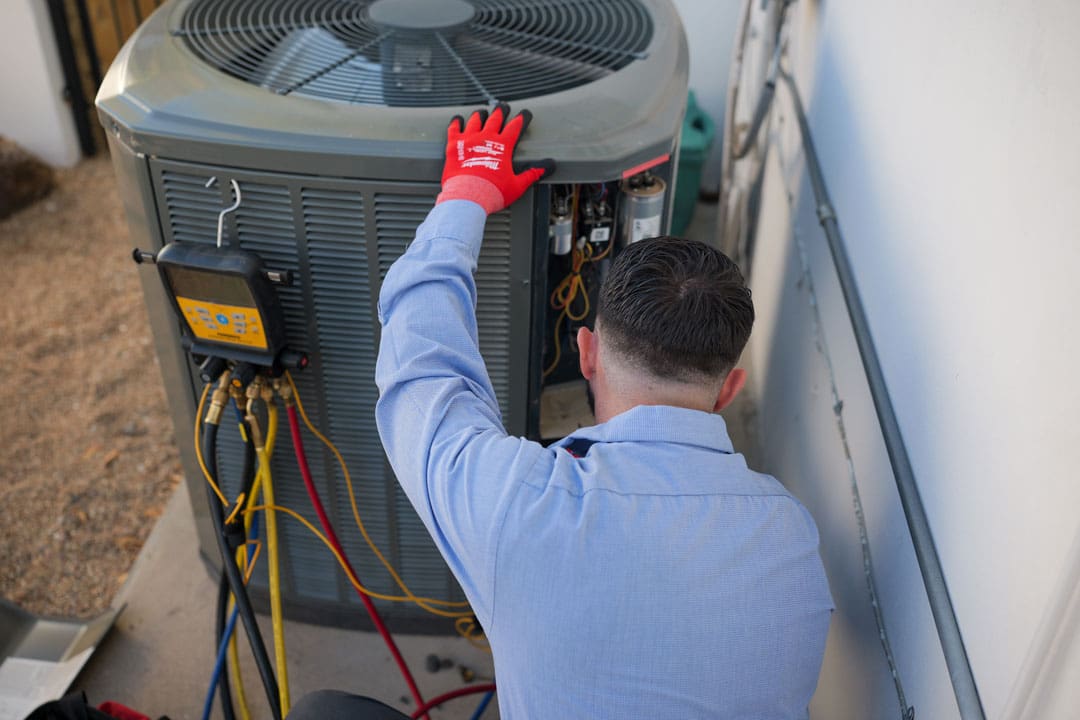
Heat pumps
Heat pumps cool like an AC in summer and use a reversing valve for heating.
No-start calls in summer still cluster around capacitors and contactors, but defrost boards and reversing valve solenoids also fail from heat stress.
Ductless mini-splits
Ductless systems from Mitsubishi Electric and Daikin run long hours in Phoenix sunrooms and additions.
Control boards and inverter modules are sensitive to surges. If the indoor head does not respond, check the breaker and the outdoor disconnect.
Beyond that, call a trained mini-split technician.
Package units and rooftop units (RTU)
These place the blower, evaporator coil, condenser coil, and compressor in a single cabinet, often on a roof curb.
Heat exposure shortens capacitor life and dries fan motor bearings.Access needs ladders and fall protection. If the unit will not start, do not climb a hot roof.
Deep-dive: components that decide whether your system powers on
Understanding the start chain helps explain why a system stays off. Here is the condensed path most Phoenix systems follow on a call for cool.
Thermostat calls for cool and sends 24V across Y and G. The air handler board energizes the blower motor relay or the ECM module.
The condenser contactor coil receives 24V and closes, sending 240V to the compressor and condenser fan motor.
Start capacitors and run capacitors then deliver the phase shift to start and run motors at proper torque.Safety controls like high-pressure and low-pressure switches, float switches, and thermal overloads can interrupt this chain.
Problems and telltales:
Thermostat malfunctions: Wrong mode, dead batteries, lockout, or blown common wire fuse. A tech checks R to C for 24V and validates Y and G output.
Contactors and relay switches: Pitted contacts or a dead coil so the compressor never gets line voltage. Visual pitting is common on units near dusty alleys in Maryvale.
Start and run capacitors: Out of tolerance parts cause slow starts or no start. Electrolyte bulging is common after two to five Phoenix summers.
Blower motor and condenser fan motor: Seized bearings or winding shorts. Squealing fan motors often warn of impending failure.
Expansion valve (TXV) and refrigerant charge: A stuck TXV or low R-410A raises superheat, trips safeties, and can prevent the compressor from staying online.
Refrigerant leaks at flare connections or rubbed copper refrigerant lines need electronic leak detection and a proper weigh-in charge by a pro.
Evaporator coil and condenser coil: Dirt acts like a blanket. The system overheats or ices. Both conditions lead to shutdown and no-start call-backs.
Local environment factors that change the troubleshooting path
Phoenix homes in 85016, 85018, and 85021 near Camelback Mountain and the Biltmore area often see fine dust that loads filters fast.
Desert Ridge and 85050 rooftops bake units in full sun. South Mountain and Sunnyslope winds blow debris into condenser fins.Near Chase Field and the Footprint Center, urban heat islands hold high night temps that increase run time.
Monsoon storms bring surges. Split systems and rooftop units take hits to control boards and transformer primaries.
Many no-start calls after a storm trace back to a failed 24V transformer or a fused board.Surge protection for the condenser and indoor unit pays for itself by preventing control board burnouts.
Long-run ductwork in Arcadia ranch homes drives static pressure above target.
A high MERV filter can push it further and trigger limits, so the indoor blower will not start or cycles off early.
Correcting duct restrictions and sealing returns in older Phoenix homes is often a better fix than swapping parts.
Brand nuances the team sees across Maricopa County
Day & Night services Trane, Carrier, Lennox, Goodman, Rheem, York, and Bryant every day.
The team also works on Daikin, Mitsubishi Electric, and American Standard equipment, from high-efficiency heat pumps to rooftop package units.
Using OEM parts protects SEER performance and keeps manufacturer warranties intact.
Brand examples:
Trane and American Standard contactors sit in tight electrical bays on some condensers. Heat soak can warp wire insulation.
Carrier rooftop package units show contactor pitting and blower relay wear after long Phoenix summers.
Lennox and Rheem control boards often include diagnostic LEDs. A steady or blinking pattern helps the tech confirm pressure switch or float faults.
Mitsubishi and Daikin ductless systems share inverter boards that are sensitive to surges. A dedicated surge protector is smart in areas near Papago Park and the Arizona State Capitol where grid switching events are frequent.
When DIY stops and a pro should take over
Certain faults are unsafe without training or tools. If you reach any of the scenarios below, contact Day & Night for AC repair Phoenix.
The dispatcher routes the closest NATE-certified technician based on your zip code for same-day relief.
- Breaker trips again after reset or there is a burning smell at the unit.
- Outdoor fan hums but will not spin, or the top is too hot to touch.
- Ice on the evaporator coil or copper refrigerant lines.
- Water overflow from the ceiling pan or signs of drywall damage.
- System starts only after long delays or shuts off within seconds.
These point to electrical faults, seized motors, refrigerant leaks, or control board issues. Fast professional service prevents compressor damage and water damage.
What a Day & Night technician does on a no-start visit
The visit follows a disciplined diagnostic path, then a precise repair.
Phoenix reliability depends on finding the root cause, not just clearing a symptom.
Steps include verifying the thermostat call, checking low-voltage power and fuses, inspecting contactors and relay switches, measuring capacitor microfarads, and checking compressor and fan motor amperage.
The tech inspects the blower motor, air handler door switch, and float switches.
If the system runs unstable, they check the expansion valve function, superheat, subcooling, and coil cleanliness.For central air conditioning restoration, they confirm airflow and static pressure, and they recommend MERV filters suited to the duct design.
If refrigerant levels are off, a leak check follows. R-410A leaks often occur at service valves or rub points on copper refrigerant lines.
The leak is repaired, the system is evacuated to proper microns, and a weighed-in charge is applied to match the nameplate.
Field advantage: Day & Night stocks heavy-duty start capacitors and universal contactors on every truck.
Many no-start issues in Arcadia, Biltmore, Paradise Valley Village, and Desert Ridge finish in a single visit without waiting for parts.
Neighborhood reach and response time across Phoenix
The fleet covers Phoenix zip codes including 85001, 85016, 85018, 85021, 85032, 85044, 85048, 85050, and 85085.
From homes under Camelback Mountain and the Biltmore area to Ahwatukee Foothills and the quiet blocks around North Mountain, the team positions for rapid arrival.
The same speed holds near Chase Field, the Footprint Center, Heard Museum, and Papago Park.
Day & Night also serves Scottsdale, Tempe, Mesa, Chandler, Glendale, Peoria, Gilbert, and Paradise Valley.
Urban, suburban, or foothills, the process is the same: quick triage, targeted part replacement, and confirmation that the system meets Phoenix heat demands.
How to avoid the next no-start: Phoenix-specific maintenance
Preventive care matters in an arid desert climate. Systems that get regular attention suffer fewer contactor burns, fewer compressor lockouts, and fewer float trips.
A smart maintenance plan pays off during the first 115°F weekend in June.
Actions Day & Night recommends for Valley homes and small offices:
Replace filters every 30 to 60 days in summer. Use MERV that meets both indoor air quality and static pressure needs.
Keep bushes and debris two feet away from the condenser.
Have evaporator and condenser coils cleaned on schedule.Treat or clear the condensate line with the right method for your drain setup.
Consider surge protectors on the condenser and indoor equipment.
Add a float switch if you do not have one.If you live near high-dust corridors in Maryvale or South Mountain, schedule an extra coil cleaning before monsoon.
For North Phoenix sunrooms and casitas, ductless mini-splits from Mitsubishi Electric can stabilize comfort without overloading the main system.
For older rooftops, upgrading to a high-efficiency Trane or Carrier rooftop package unit increases reliability and reduces peak kWh draw.
Real Phoenix scenarios that match your home
An Arcadia homeowner reports a dead system on a 112°F afternoon. The fix is a failed start capacitor at the condenser.
The tech replaces it, checks compressor amps, and washes the condenser coil. The home cools within minutes.
A Desert Ridge rooftop unit will not start after a monsoon. Diagnosis shows a blown 24V transformer and a tripped high-pressure switch from a matted coil.
The transformer and contactor are replaced, refrigerant pressures are verified, and the coil is cleaned to restore safe head pressure.
In 85032, a heat pump short-cycles and then refuses to start for hours. The cause is a clogged condensate line tripping the float switch.
The line is cleared, a pan treatment is added, and the system is checked for proper superheat and subcooling.
What matters for warranties and long-term performance
Many manufacturers require proof of proper installation and service.
Calling a qualified HVAC contractor protects warranty standing, especially on brands like Trane, Carrier, Lennox, York, Rheem, and Bryant.Using OEM parts preserves SEER ratings and AHRI-matched performance.
Work recorded by NATE-certified technicians is favored by insurers and building managers in Phoenix and throughout Maricopa County.
Commercial no-start considerations for Phoenix facilities
Rooftop units over restaurants near Chase Field or offices near the Arizona State Capitol face grease, dust, and long run hours.
Common outages include failed condenser fan motors, pitted contactors, and clogged economizer filters.Day & Night’s commercial HVAC repair playbook includes blower motor RLA checks, belt tension verification, economizer calibration, and contactor replacement on the same visit when possible.
A commercial call also includes checks of phasing on three-phase units, verification of TXV operation under high ambient load, and inspection of copper refrigerant lines on long runs for rub points.
Emergency AC service is available 24/7 for tenant-impact events.
Search behavior in Phoenix and finding real help fast
In a heat wave, most people type emergency air conditioning repair near me or AC repair Phoenix.
A reliable provider shows local knowledge, carries parts to solve frequent failures, and responds fast to zip codes like 85018, 85032, and 85050.That is how Day & Night operates each summer across Maricopa County.
FAQ for Phoenix homeowners before calling for service
Why does the system wait several minutes before starting after I reset the breaker?
Most compressors include an anti-short-cycle timer. It protects the compressor from starting against high pressure. Five minutes is common in Phoenix controls.
The thermostat is set to Cool, but nothing happens. Is the thermostat broken?
Not always. A popped 3A or 5A fuse on the air handler board or a bad 24V transformer can cause the same symptom. A tech checks R and C voltage to confirm.
Can I hose off the outdoor coil to fix a no-start?
Light rinsing is harmless, but pressure-washing can bend fins and push water into electricals. If the unit is not starting, there is likely an electrical or safety trip that water will not fix.
The indoor unit runs, but the outdoor unit is dead. What now?
That pattern suggests a bad contactor, failed start capacitor, tripped high-pressure switch, or a failed outdoor disconnect. A pro can confirm in minutes.
Do I need a larger system for Phoenix heat?
Upsizing is not always the answer. Many no-start and poor-cooling issues track back to airflow, duct restrictions, or maintenance. An engineering-grade load calculation and duct review give the right path.
Need fast AC repair in Phoenix? Read this, then get help now
If the checks above did not restore cooling, the safest move is to schedule a visit. Day & Night provides 24/7 emergency air conditioning repair near you across Phoenix, AZ.
Expect NATE-certified, uniformed experts, same-day service, and a fixed-price guarantee.
Current offer: $50 off AC repair for residential clients in Phoenix zip codes including 85016, 85018, 85021, 85032, 85044, 85048, 85050, and 85085.
Ready to get cool again? Contact Day & Night Air Conditioning, Heating, & Plumbing now. Mention “AC repair Phoenix” to route your call for the fastest dispatch in Maricopa County.
NATE-Certified Technicians
ROC #133378BBB A+ Rating
Same-Day Service
Day & Night Air Conditioning, Heating & Plumbing 3669 E La Salle St,
Phoenix, AZ 85040 (602) 584-7758 www.dayandnightair.com AZ Licenses: ROC335883 | ROC335884 Google Maps | Facebook | Instagram | LinkedIn